

This blog shares the research experiences and findings conducted at University of North Carolina Wilmington (UNCW faculty and students) in conjunction with Plastic Ocean Project. Earlier posts share open-ocean sampling and adventures in the North and South Atlantic, the South Pacific and the North Pacific Great Pacific Garbage Patch. Outreach and education is the primary purposes to bring global awareness to an issue that has reached a crisis level in the marine environment.
Friday, August 3, 2012
"That is the sickest sample I've seen so far"

Monday, July 23, 2012
When the Media Pays Attention-We Have the World's Attention
 |
| Art educating science in French mag |
Because of social media, more and more everyday people are becoming aware how we can become better stewards of the earth. It's not like we are being nice as much as it is "getting it," that what we do to the planet we inevitably do to ourselves, our children and grandchildren. Over use of plastics, made from chemicals, gets into our soil, our animals that we eat, and also causes premature death through entanglement and ingestion. As many as 55 different species are negatively impacted by plastic pollution. Extinction rates are on the rise due to pollution and since we need to eat and drink of the same water and foods, we might be on that endangered list some day. But not if we can help it and we can. Through art, science, outreach, education, Texting, blogging, Facebooking, and Tweeting we can educate each other on what works for a sustainable planet and what doesn't.
 |
| Endangered Platypus killed by plastic ring |
 |
| Evidence land animals eat plastic |
Plastics are so ubiquitous that it's now invaded the natural world beyond ingestion and entanglement. Birds are using the materials for nests (See video below) and some birds that feed on the water surface actually feed plastics to their chicks. Others, like sea turtles confuse plastic film materials like packaging and bags for food.
 |
| Turtle eating plastic became entangled in it. |
These are just a few quick reasons why we need to figure out a different resource other than toxic petroleum and natural gas to make our products. Something that is durable yet doesn't last in the environment for 400-1000 years, especially when we are only using it once.
I'm going to be on the radio today if you want to take a listen. Or, listen to the podcast of the show as soon as it airs July 28th and 29th. It will posted on www.sustainabilitynewsandentertainment.com
Sunday, July 22, 2012
 |
| Kila preparing CTD |
 |
| Preparing sediment traps |
 |
| Kila and Angela Tomasini sort plastic from Sargassum |
Thursday, July 12, 2012
Sea Life Amid Lifeless Plastic

Shane said he was aware of plastic in the ocean, especially in the North Pacific gyre, but was not expecting the magnitude of what we found in the North Atlantic gyre. He said, “It [the plastic sampling] was definitely an eye opener. I didn’t realize it would be to that scale. Each of our trawls we only collected small amounts of plastic, but multiply that by the thousands of kilometer of ocean and we’ve got a big problem here.”
 |
| biological or cellophane? |
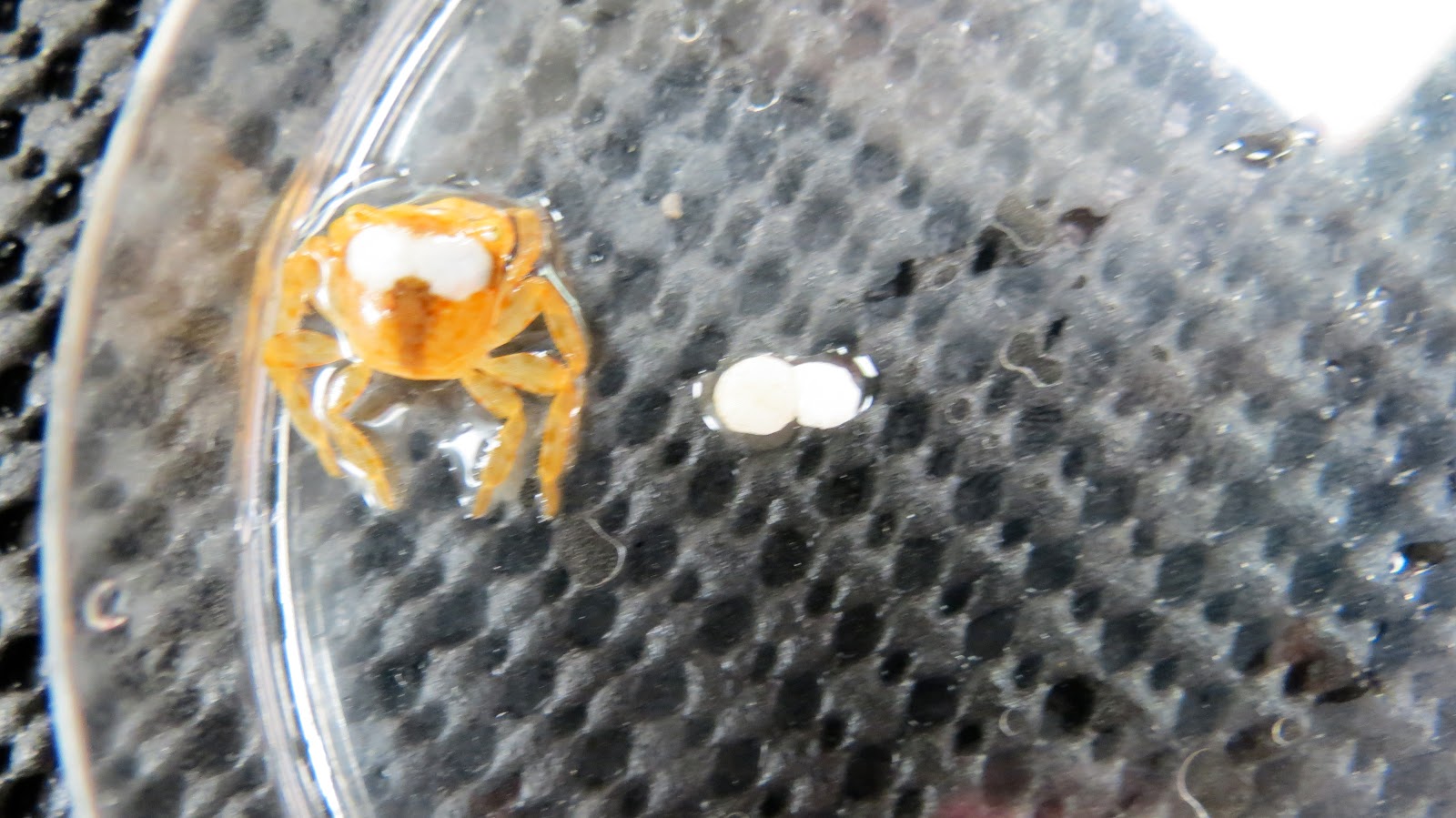 |
| spotted crab compared to plastic |
Pulling young students into research experiences has the adage of bringing the parents in as well. Shane’s mother works for the Bank of Bermuda, and though her bank is a huge financial backer, she has never been on the ship. Because of Shane, she received her first tour hours before we left for the open sea. By bringing parents in, it can come full circle when they provide info useful for research. Shane’s father told us about Sargassum sea slugs. In my many years of looking at Sargassum, I didn’t even know they existed. When Angela Tomasinna had one fall out of some Sargassum she was sorting, we put it in water and it instantly started jammin’ like a rock star. I fell in love with this little creature – who knew slugs could be adorable!
 |
| Beautiful Nudibranch the size of a dime |
Looking out over the ocean, there is little indication of life other than an occasional flash of a fish, turtle, or marine mammal. But what thrives below the surface is a world of precious species. Some so small, you need a microscope to see, yet, provide every other breath we breathe. But when chemicals, oil, and plastic (a combination of the two) get into this environment, they can destroy the sensitive balance that makes life possible. This last cruise has, more than ever, encouraged me to continue bringing the ocean to those who do not have access. I hope by doing so, people will fall in love with everything from the Sargassum slug on up to the sharks that keep the ocean in harmony. As Jay Nichols once said, “We will protect the things we love.”
Saturday, July 7, 2012
Amazing Pictures from Just Below the Surface of the Sea
 |
| Anika on Aft Deck documenting OFP |
The first time I heard about the Oceanic Flux Program (OFP)
was when Dr. Maureen Conte came to give a lecture to my class while I
participated in the Semester in Environmental Science (SES) program in Woods
Hole, MA at the Marine Biological Laboratory (MBL). The lecture was mostly
about the flux of organic matter in the ocean, from the surface to the deep and
back, and concluded with a brief summary of Maureen’s OFP work in the Sargasso
Sea. I was instantly enthralled and had a burning desire to find out more than
what I had gained in a mere 15 minutes.
Consequently, I emailed Maureen to schedule a meeting to
learn more about her research and get some possible ideas of research projects
I could carry out in my last 5 weeks of the program using techniques similar to
those of her OFP work. In my project, I extracted organic compounds from
particulate organic matter (POM) – suspended particles, such as detritus, in
the water column – and used this information to tell a story about the
communities living in the water column, their environmental conditions and how
they might be shaping it.
When completing my SES research, Maureen invited me to come
work for the OFP program this summer and so here I am in the middle of the
Atlantic getting to experience firsthand the science that hooked and held my
attention in that SES lecture. I feel like I’m coming full circle now from my
own SES project, tying in the basics that I learned to the big picture of long-term
ocean climate changes. My job is trying to figure out what exciting events have
been happening in the big blue Sargasso Sea and I love it. ****************************************************
 |
| Plastic in Sargassum |
 |
| Argonatus argon octopus |
Last night, we ran a sample that netted 65
cm of Sargassum along with marine
life far different from the day samples. When we dumped the sample into the
sorting tub we noticed two beautiful Nautilus-like shells each connected to a
small octopus among an array of other invertebrates. It is difficult to stay on task plucking
plastics when there are so many creatures we’ve never seen before swimming
around in our sample. The
only way to sort out the plastic fragments is to handpick through all of the
weed. It took five of us over an hour to sort - blurry-eyed by the time we shut the lab lights out at 1am.
 |
| Seahorse feeding off bottom of tank |
Tonight the sea state settled down to a series
of gentle ripples and from past experiences when the sea state flattens, more
plastics tend to appear in our samples. True to form, we had a record amount of
plastic than the previous 12 samples.
But that wasn’t all we found, our trawl pulled in an 10 cm
seahorse. We’re giving the credit to
Harry the seahorse whisperer. Now the
trick is to keep it alive so we can return it to the ocean when the ship stops
at 0430 Sunday.
 |
| Bill holding seabird on deck |
Tomorrow we will be steaming back to
Bermuda with plenty of stories to share about the ubiquitous plastics we
collected, the amazing Sargassum
fish, the octopi, the seahorse, and a bird that I saw fly into the CTD garage. Bill found it on the floor and gently picked
it up as it came-to. It went from being
confused, to frightened, to relaxing in Bill’s tender touch. We snapped photos, then took it to the bow
where it was dark so it wouldn’t get confused by the lights blaring on the aft
deck. Bill opened his hand slowly as the sea bird composed itself before it sprang
from his hand wings open and flew across the moonlit sky.
This cruise started out with the focus on
plastic pollution and ended with a greater appreciation for the marine life in
the open sea. It made me realize the
delicate balance of life above and below the surface and that it is worth
protecting.
Launching a Million Dollar Ocean Sampling Device

Yesterday we retrieved the sediment traps that have been tethered
to the ocean floor for roughly four
months. This diagram illustrates the
rigging. There are a series of bottles
located under the large yellow funnels.
The bottles are on a timer that advances each of the many empty bottles
to the base of the funnel after a specified period of time. This
is the main reason we are out here. Dr.
Maureen Conte is the primary investigator of the Oceanic Flux Program (OFP)
time-series and has been for over 30 years.
The sediments collected in these traps tell us about the influence of the
ocean surface on the physical and biological processes over time scales of
weeks to decades and how particles flux in the water column. This hydrography
provides unprecedented opportunities to study the biology, chemistry, and ocean
physics especially over a long period of time.
Why is it important? Because this study helps us understand the reprocessing
of these particles, like carbon emissions, ocean acidification, or suspended plastics. The OFP is the longest running open-ocean
research of its kind dating back to 1978 and made possible through funding by
the National Science Foundation (NSF). Thank
you NSF!
 |
| Anika Aarons and Angela Tomassina prepare sediment trap. |
Today, we are 75 km SE of Bermuda. We returned the sediment traps to the sea with
fresh bottles. Anika Aarons, a grad
student at Mount Holyoke, assisted Maureen in the process. But it took all deck hands and marine techs
to launch these gigantic sinkable “rubber duckys” that require thousands of pounds
of steel, galvanized line, glass spheres the size of beach balls, and
waterproof instrumentation accompanied by a 2,400 lb. anchor. With all of this
heavy machinery and equipment on the aft deck, hardhats are a necessity. Anika will be ghost-blogging her experience
working on the OFP later today and I will share what we found in our surface sampling late last night.
Friday, July 6, 2012
Harry the Seahorse Whisperer
 |
| Harry Masters opening Nikin Bottles |
Harry Masters is here helping Michael Gonzior prepare the Rosette CTD (Conductivity, Temperature, and Depth device) for a 4700 meter cast down
into water that is thousands of years old. Water that will take centuries before it returns to the surface. Michael is
looking at the water disolved organic matter or profile. Like fossils, water has distinct elements
that can provide insight into the past.
In the photo you can see Harry opening up the Niskin bottles on the CTD wrapped around the circular frame like horses on a carousal. The bottles will capture the ancient water. The marine techs and deck
hands will use an electronic winch to lower the CTD until it reaches the
designated depth. The bottles will then
receive a signal to snap shut and the CTD will make its way back to the
surface. The entire process takes
several hours because it travels about 15 meters a minute.
Harry, born and raised in Bermuda, recently graduated from
the University of North Carolina Chapel Hill with a degree in Environmental
Studies and Public Policy with a minor in Entrepreneurship. This is his first open-ocean cruise on a research
vessel and says he is loving every minute of it, from helping with the CTD to
keeping the ever-growing collection of biota alive that we net from our surface
sampling.
 Harry has grown particularly fond of a 6 cm Histrio histrio
also called a frogfish or Sargassum
fish. I have come to calling it “King Pin.” Notice how its coloring mimics the Sargassum. Another unique characteristic is the way it can use its fins like hands - grabbing on to the Sargassum as it perches in the weed waiting for food to swim by. We have been able to observe the eating habits of many of the species
due to the Sargassum ecosystem we
have created in our 10-gallon fish tank, for exampe, crabs eat not only the abundant
shrimp found in the Sargassum, but
also eat each other. But they are not
the only ones cannibalistic. Harry was
trying to catch a smaller Histrio histrio for Maureen Conte for the purpose
of studying the lipids in this species.
Harry ended up having to find another one to catch. When the little fish
swam past King Pin it abruptly disappeared like a fly on the tip of a frog’s
tongue. Now we know, Histrio histrio
also eat it’s own kind. Because we have
quite the collection, Harry managed to collect three for Maureen. This has been a particularly good hands-on
experience for the graduate who, toward the end of his undergraduate studies, became
interested in Marine Biology. During the
last few months of college he worked in a lab studying the gene expression in
diatoms under different iron conditions.
Harry has grown particularly fond of a 6 cm Histrio histrio
also called a frogfish or Sargassum
fish. I have come to calling it “King Pin.” Notice how its coloring mimics the Sargassum. Another unique characteristic is the way it can use its fins like hands - grabbing on to the Sargassum as it perches in the weed waiting for food to swim by. We have been able to observe the eating habits of many of the species
due to the Sargassum ecosystem we
have created in our 10-gallon fish tank, for exampe, crabs eat not only the abundant
shrimp found in the Sargassum, but
also eat each other. But they are not
the only ones cannibalistic. Harry was
trying to catch a smaller Histrio histrio for Maureen Conte for the purpose
of studying the lipids in this species.
Harry ended up having to find another one to catch. When the little fish
swam past King Pin it abruptly disappeared like a fly on the tip of a frog’s
tongue. Now we know, Histrio histrio
also eat it’s own kind. Because we have
quite the collection, Harry managed to collect three for Maureen. This has been a particularly good hands-on
experience for the graduate who, toward the end of his undergraduate studies, became
interested in Marine Biology. During the
last few months of college he worked in a lab studying the gene expression in
diatoms under different iron conditions.
Harry and I compared being on this ship like the life
support in the Sargassum ecosystem. Everyone
has a role or purpose. Each supports
each other from the cooks preparing awesome food to the deck hands that make
the science happen, to the captain and crew that get us where we need to be
safely. It is the science that provides
the jobs and it the science that perpetuates better understanding of how we can
be amiable stewards to the sensitive ecosystems we depend upon.
Recently, while hanging out at the beach with some friends, Harry
looked down at something moving in beached Sargassum. It was a 4” seahorse heaving for air. He and his friend worked together to get it
out to the reef. Harry held it gently in
his hand underwater, the seahorse wrapped its tail around his finger, and his
friends towed Harry on his boogie board to the reef. Science works the same way. It begins by opening your eyes to the world
around you and then asking a question like, “What is this?” and then attempting
to find the answer.
Later we will show pictures of the plastic we are finding in our samples as well as the main event, the retreaval of the OFP mooring.
Subscribe to:
Posts (Atom)